Should I Let My Kid Lift Weights?
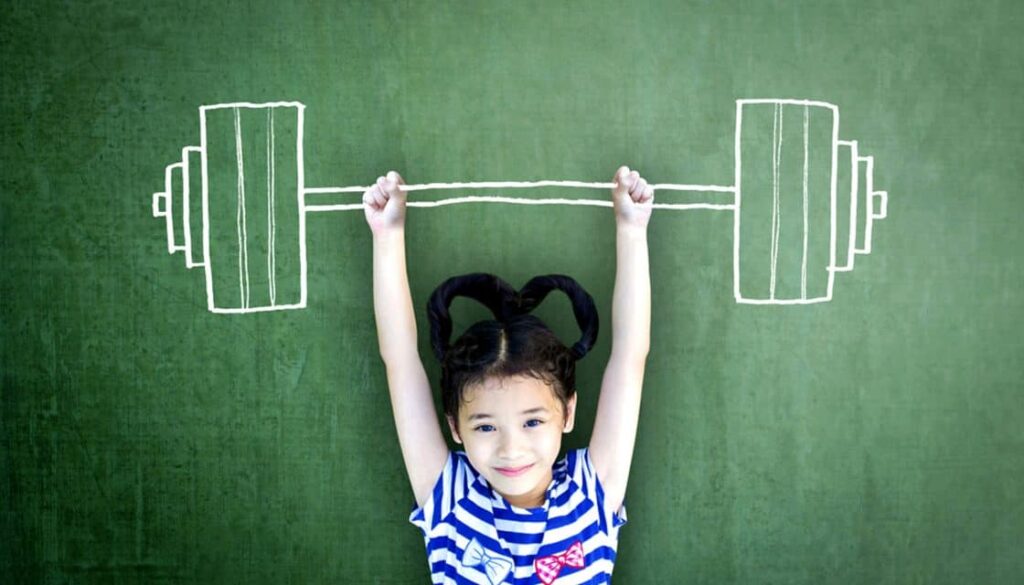
I was just asked by a friend whether she should protest against her eleven-year-old’s interest in lifting weights. This gave me pause, because my knee-jerk response (“no!”) is based on hearsay, teaching from more experienced physicians while I was in training.
After looking into the studies on weightlifting in children, it turns out that it can actually be beneficial. This is good news, given how much strength and resistance training are incorporated into youth sports. Here are some takeaways that surprised me:
Weight Training Does Not Stunt Growth
Despite theoretical concerns about damage to growth plates in a developing musculoskeletal system, studies fail to show stunted growth in children who engage in weightlifting. In fact, as with adults, weight and resistance training appear to have an overall positive impact on bones, muscles, and cardiorespiratory systems. Having noted this, I advise against pushing to maximal load or training to failure in children who are still growing.
Injuries Are Not Common
Of course, injuries can happen anywhere, but the risk of injury with weight training is less than in many other youth sports. Most weightlifting injuries are related to poor technique, overuse, improper equipment use, or unsupervised training on home equipment. Working with a trainer can mitigate these risks. In addition to teaching proper technique, trainers will increase load gradually and spot your child. To prevent injuries, work with a certified and experienced trainer, and always ensure your child is supervised.
How To Start Weight Training
Weight training can be overwhelming. Even adults should progress gradually under the supervision of a reliable trainer. Limiting younger children to calisthenics and body weight training (pushups, planks, curls) is a great way to allow kids to independently workout and track their progress (number of reps, time in plank). According to Ramses Ruiz, a certified personal trainer, this will serve as a foundation. Next, kids will learn proper techniques, including bracing, breathing, and form. Along with others in the field, Ruiz contends that these skills help prevent life injuries, like when you help your friend move a sofa or you lift a heavy suitcase into an overhead bin.
Reasons Not To Weight Train
Despite this positive outlook, from a developmental and social standpoint, I would still discourage my friend from letting her eleven-year-old start lifting. It is one thing to train as a group with your team, but her child is eleven. For exercise, I would encourage him to be outside and engage with playmates. But if he is seriously into building muscle, then, hey, it is not the end of the world. In fact, there is an entire world of youth weight lifting competitions that start as early as age eight!
Takeaways
- Work with a trainer who is certified and experienced with children and teens.
- Start with body weight exercises.
- Increase load gradually. Avoid maximal loading.
- Proper techniques (including bracing, breathing and form) reduce injuries.
- Ensure supervision during all weight training sessions.
- Encourage outdoor play and group activities, especially for younger children.
Thank you for reading my human-generated articles! If you found this helpful or educational, please share, follow on your preferred platform or subscribe below. For coaching or consultations, please contact me at www.DrAngel.com.
References:
Pierce, Kyle C et al. “Weightlifting for Children and Adolescents: A Narrative Review.” Sports health vol. 14,1 (2022): 45-56. doi:10.1177/19417381211056094 https://pmc.ncbi.nlm.nih.gov/articles/PMC8669931/
Faigenbaum, Avery D et al. “Youth resistance training: updated position statement paper from the national strength and conditioning association.” Journal of strength and conditioning research vol. 23,5 Suppl (2009): S60-79. doi:10.1519/JSC.0b013e31819df407 https://pubmed.ncbi.nlm.nih.gov/19620931/