Why You May Need to Start Fake Laughing
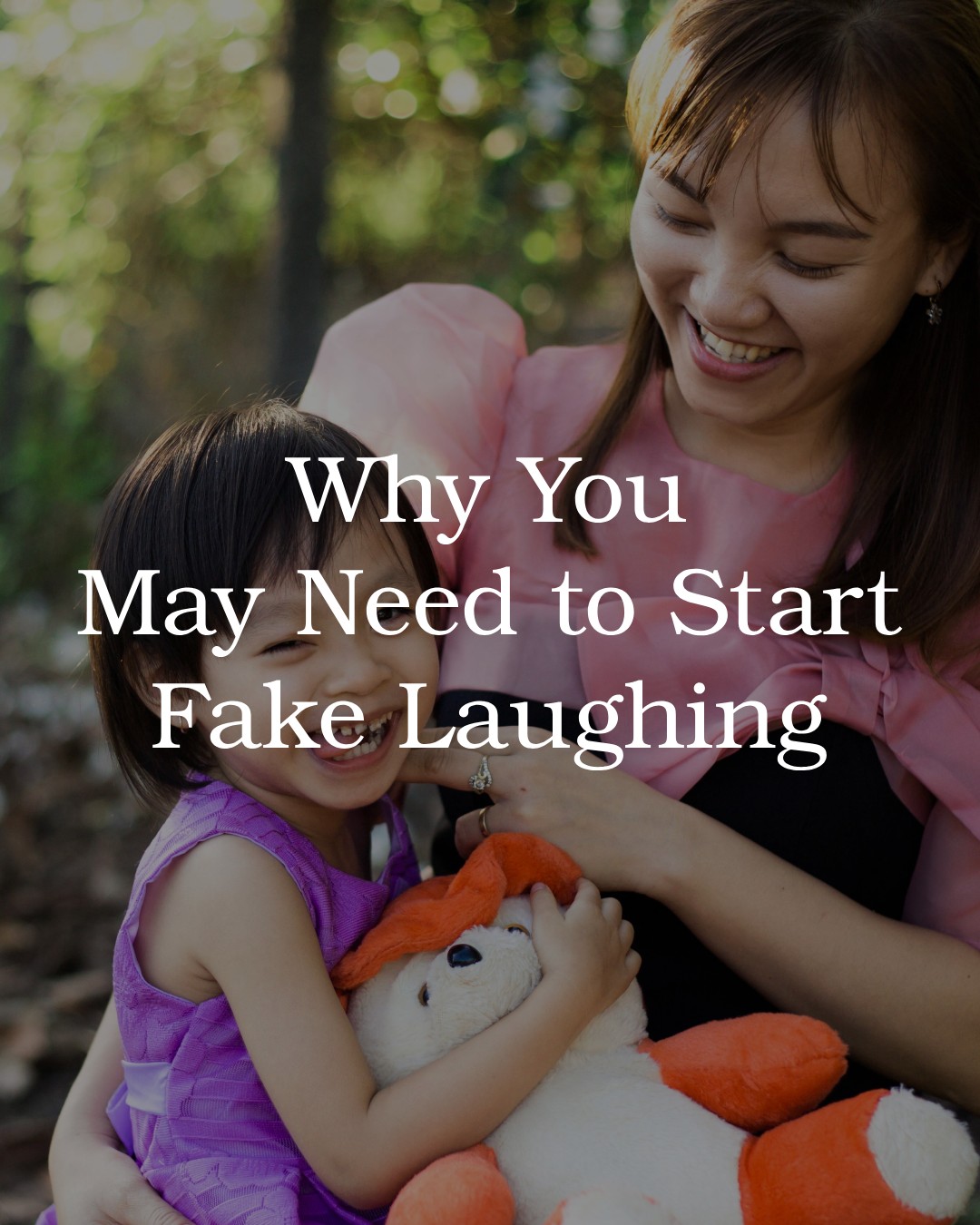
My kids routinely get the jippies, what they define as uncontrollable laughter, usually about something nonsensical, and it’s contagious between them. My husband and I are usually confused and sometimes irritated, though recently, I am experimenting with a new approach: if I can’t beat ‘em, maybe I should join them.
Laughter starts at a young age, and studies link laughing in the first 3-6 months of life to more secure attachment. A parent’s laughter allows a child to feel relaxed and safe, often guiding them how to respond to new stimuli, like an unfamiliar face or a startling sound. Laughter also releases neurotransmitters that support healthy brain development.
Kids love laughing, but as they enter the preschool years, they tend to find their laughter buddies in peers instead of their parents, who seem to steadily withdraw from laughter. Laughter is a social phenomenon, and even before screen time started replacing face-to-face interactions, adults were laughing less than three times a day. What’s worse is that we don’t even try. We say, “That’s funny,” or even worse “LOL,” out loud instead of actually laughing.
Here is WHY and HOW I recommend laughing more:
Laughter is good for your mental, immune, and cardiovascular health. While many of us can intuit that laughter boosts mood, we may not realize that immune cells function better and that blood flow improves with laughter.
Laughing is a quick stress reducer. Cortisol, a measure of stress, comes down with laughter. A giggle is an easy way to force quit when you find stress is mounting. Short bursts of laughter during the day — even if it’s forced laughter — reduces stress.
Set a laughter goal. I had to do this myself. I set a goal of laughing at least three times a day. I know that seems pathetic, but I wanted to set an attainable goal (and to be honest, my initial goal was to laugh once a day), knowing that lofty goals are often left unmet and eventually tabled. A small laughter goal can be a foundational step towards letting your natural laughter back in.
Fake laughing is just as good — if not better — than real laughing. This surprised me, but studies consistently show that fake laughter, a technique used in laughter yoga, results in the same health benefits as natural laughter. And it does not have to last long. Short bursts of fake laughter can do the trick as well.
Play with your kid. Playing is fun. When children are young, parents often get on the floor, crawl, tumble, make silly faces — and laughter follows naturally. . Parents tend to outgrow this kind of play as their kids get older, but we don’t have to. Next time your little one invites you to play, really get into it. Let your inner child re-surface. Fake laugh if you need to. Your kid will probably find you hilarious.
Practicing mindfulness may help you laugh more — and connect more. If you can remind yourself to be present during the times you are with your loved ones, you may be able to enjoy them more. Sometimes, as parents, we are so rushed or stressed or juggling multiple tasks that we are unable to enjoy the moment. And in this moment , your kid may say something funny, or look at you for acknowledgement, or try to entice you to join in the jippies. It’s okay to give in sometimes. Those small, fleeting moments may be the ones that your child will remember the most.
In Summary
Laughing, it turns out, is essential for your child’s health and your own. If you find yourself wanting to laugh more, set a laughter goal. Fake laughter is just as effective. But if your goal is to connect with your child (or anyone, for that matter), being present, allowing yourself to be silly, and delighting in the moments your child delights in is where the real joy lives.
Thank you for reading my human-generated articles! If you found this helpful or educational, please share, follow on your preferred platform, or subscribe below. For concierge parent coaching or consultations, please contact me at www.DrAngel.com.
For more perspective on what it takes to have and raise a thriving little human, check out my show, The Unplanned Parent, on Apple, Spotify, YouTube, or wherever you listen to podcasts.
References:
Mireault, Gina et al. “Infant humor perception from 3- to 6-months and attachment at one year.” Infant behavior & development vol. 35,4 (2012): 797-802. doi:10.1016/j.infbeh.2012.07.018
Scott, Sophie K et al. “The social life of laughter.” Trends in cognitive sciences vol. 18,12 (2014): 618-20. doi:10.1016/j.tics.2014.09.002
Mireault, Gina C et al. “Laughing matters: Infant humor in the context of parental affect.” Journal of experimental child psychology vol. 136 (2015): 30-41. doi:10.1016/j.jecp.2015.03.012
Mora-Ripoll, Ramon. “Potential health benefits of simulated laughter: a narrative review of the literature and recommendations for future research.” Complementary therapies in medicine vol. 19,3 (2011): 170-7. doi:10.1016/j.ctim.2011.05.003