Three Interventions to Help Your Tween or Teen Get More Sleep
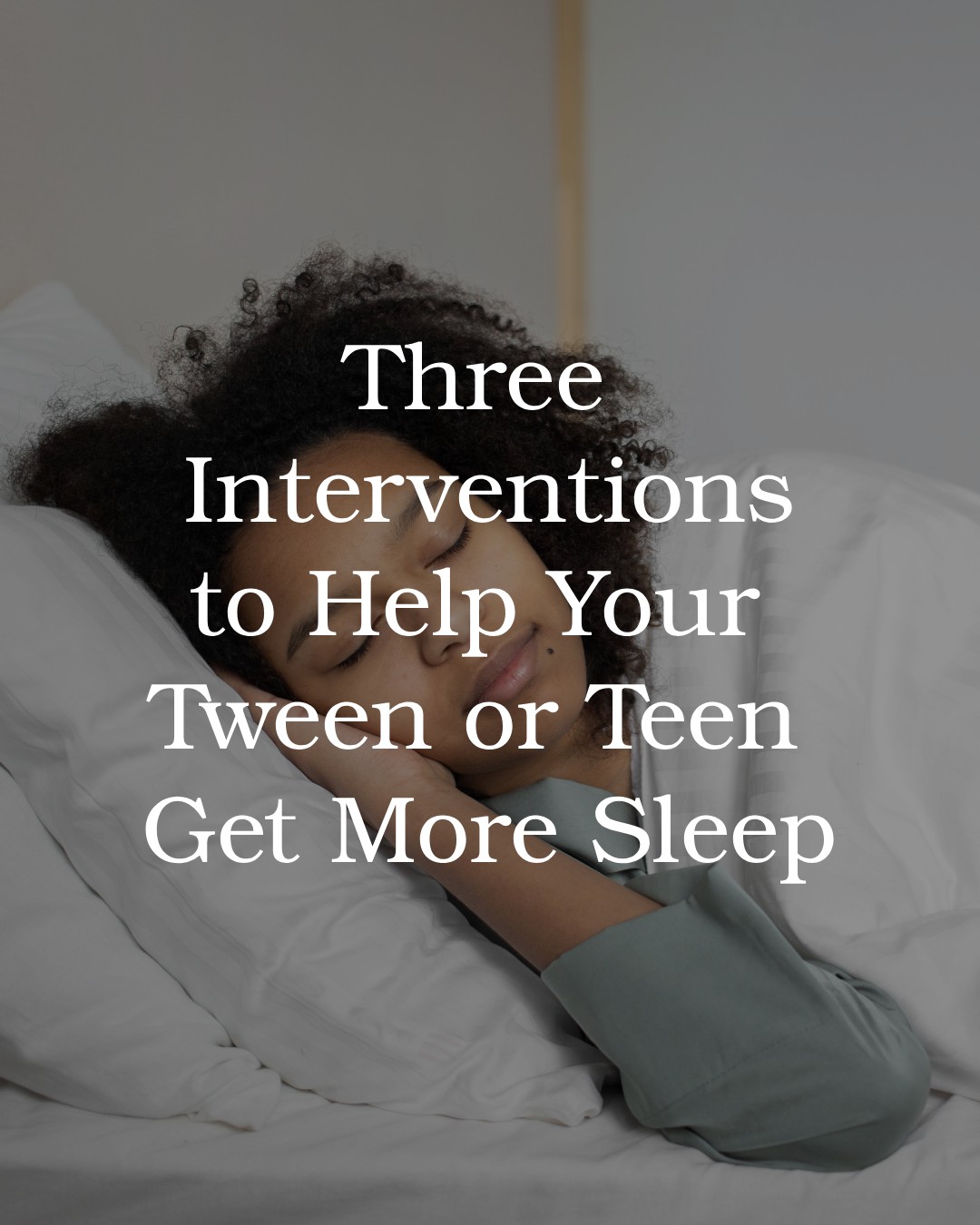
If you’ve read my other articles, you know that sleep is the foundation of physical health and social-emotional well being. In fact, a recent study in Psychological Medicine found that, when it comes to teen mental health, sleep was the most important modifiable lifestyle factor — even more influential than physical activity, screentime, or diet. Whether due to their rapidly developing neurologic connections or the body’s physiologic need for sleep in order to grow, sleep is essential to adolescent health.
Knowing the value of sleep does not make it any easier to attain. For many, between busy work schedules, homework, soccer practice, or habit, sleep is readily deprioritized. When parents ask for effective interventions, here are three research-backed recommendations I offer:
Set Bedtimes.
Don’t let the simplicity of this intervention fool you. Teens whose parents set bedtimes sleep more. While school-aged kids need about 9-12 hours of sleep and teens need closer to 8-10, the majority fall short of this. If your teen does not have a bedtime, it’s not too late. Research supports the introduction of a bedtime, resulting in improved sleep duration. Interestingly, when compared to teens with later or no bedtimes, teens with a set bedtime of 10 pm or earlier had a lower risk for cardiovascular disease decades later, highlighting the anti-inflammatory effect of sleep.
Keep Screens Outside the Bedroom.
Common Sense Media and honest teens in my practice report that adolescents not only stay awake at night to scroll, they wake up in the middle of the night to check their devices. And adults are similar, with some 25% admitting to personal devices cutting into their sleep. Not only does this reduce the quantity of sleep, it disrupts sleep quality and results in daytime sleepiness. Even if teens do not access their devices at night, the mere presence of the device with its associated buzzing of notifications can cause sleep disturbances. Keep bedrooms device-free from an early age, and equally important (though perhaps more difficult), role-model this for your children. If your teen is in college and devices must be in a dorm room, ensure notifications are off, and encourage your teen to work with roommates to align for mutual prioritization of quality sleep.
Reduce Caffeine Intake.
Research and common sense agree that sleep quality and duration improves with reduced caffeine intake. In addition to coffee drinks, beverages like boba teas, matcha, and energy drinks are popular among teens. Especially for busy teens, caffeine can feel like an easy, quick fix to staying alert during class after a long night of homework. However, overconsumption of caffeine can contribute to a vicious cycle of chronic sleep deprivation, harm memory retention, and even worsened academic performance. Talk with your teen about their beverage choices — maybe they can switch to decaffeinated options or limit consumption to mornings. If all else fails, appeal to their vanity and mention that caffeine-containing drinks often stain teeth.
The Breakdown.
Sleep modulates health, promotes physical and mental recovery, and is central to life satisfaction. And while optimizing sleep will not solve all health problems, it can certainly improve symptoms of anxiety, depression, and inattention. Share this information with your teen so you can support their sleep habits.
You may also enjoy reading Mom, Why Can’t I have Caffeine or Healthier and Happier Kids? Sign Me Up.
Thank you for reading my human-generated articles! If you found this helpful or educational, please share, follow on your preferred platform, or subscribe below. For concierge parent coaching or consultations, please contact me at www.DrAngel.com.
For more perspective on what it takes to have and raise a thriving little human, check out my podcast, The Unplanned Parent, on Apple, Spotify, YouTube, or wherever you listen or watch.
References:
Smucny, Jason et al. “Mediating effects of healthy lifestyle factors on associations between mental health and functional outcomes in early adolescence.” Psychological medicine vol. 56 e215. 7 Jul. 2026, doi:10.1017/S0033291726105121
Wheaton, Anne G et al. “Short Sleep Duration Among Middle School and High School Students – United States, 2015.” MMWR. Morbidity and mortality weekly report vol. 67,3 85-90. 26 Jan. 2018, doi:10.15585/mmwr.mm6703a1
Munzer, Tiffany et al. “Digital Ecosystems, Children, and Adolescents: Policy Statement.” Pediatrics vol. 157,2 (2026): e2025075320. doi:10.1542/peds.2025-075320
Bauducco, S V et al. “It’s past your bedtime, but does it matter anymore? How longitudinal changes in bedtime rules relate to adolescents’ sleep.” Journal of sleep research vol. 33,2 (2024): e13940. doi:10.1111/jsr.13940
Addo, Prince Nii Ossah et al. “Parent-set bedtime in adolescence is associated with future cardiovascular disease risk: Evidence from the Add Health study.” PloS one vol. 20,12 e0339044. 16 Dec. 2025, doi:10.1371/journal.pone.0339044
Robb M. The New Normal: Parents, teens, screens, and sleep in the United States. Common Sense Media. 2019. Accessed November 15, 2024. https://www.commonsensemedia.org/sites/default/files/research/report/2019-new-normal-parents-teens-screens-and-sleep-united-states-report.pdf
Munzer, Tiffany et al. “Digital Ecosystems, Children, and Adolescents: Technical Report.” Pediatrics vol. 157,2 (2026): e2025075321. doi:10.1542/peds.2025-075321
Carter, Ben et al. “Association Between Portable Screen-Based Media Device Access or Use and Sleep Outcomes: A Systematic Review and Meta-analysis.” JAMA pediatrics vol. 170,12 (2016): 1202-1208. doi:10.1001/jamapediatrics.2016.2341
Zhong, Ling et al. “Modifiable dietary factors in adolescent sleep: A systematic review and meta-analysis.” Sleep medicine vol. 115 (2024): 100-108. doi:10.1016/j.sleep.2024.02.009
Halldorsson, T I et al. “Caffeine exposure from beverages and its association with self-reported sleep duration and quality in a large sample of Icelandic adolescents.” Food and chemical toxicology : an international journal published for the British Industrial Biological Research Association vol. 157 (2021): 112549. doi:10.1016/j.fct.2021.112549
Zhang, Jie et al. “Explore the impact of sleep-related factors on anxiety in adolescents: A meta-analysis of cross-sectional, longitudinal and RCT studies.” Journal of affective disorders vol. 404 (2026): 121320. doi:10.1016/j.jad.2026.121320