Growth Charts 101: From Basic to Nuanced
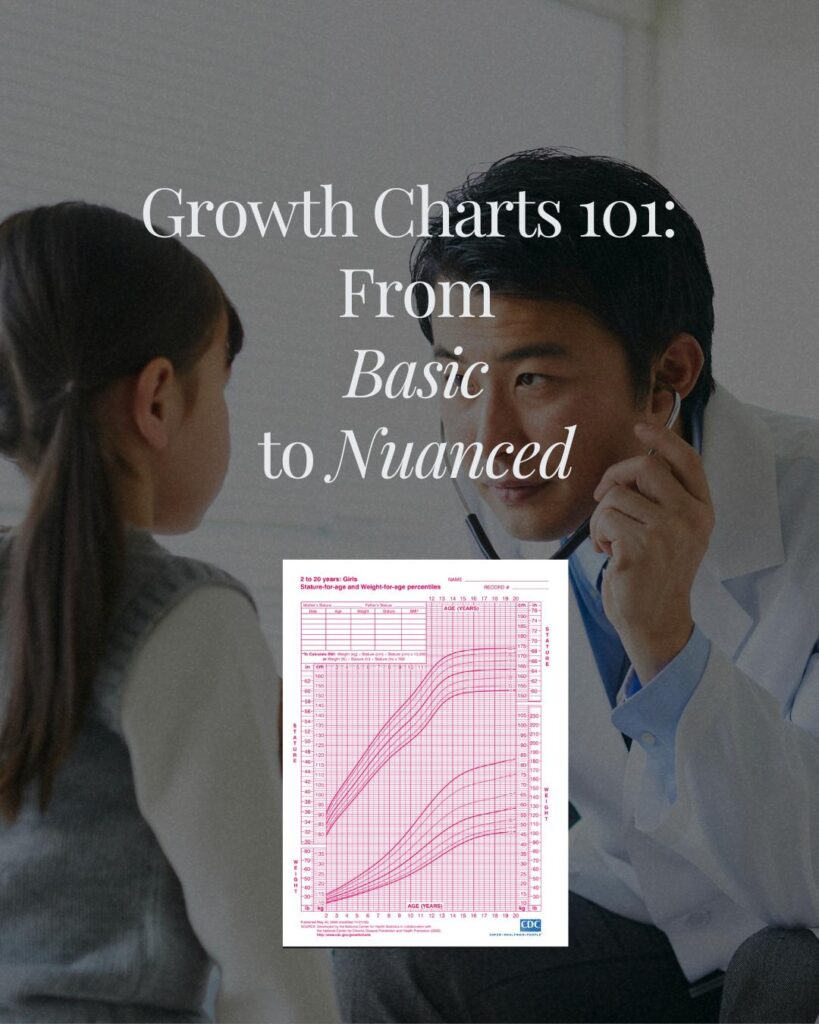
Growth charts are of central importance to the pediatric visit, and hopefully your doctor is sharing your child’s growth information with you at every well check.
While growth charts seem fairly logical– your child’s growth parameters are compared against standards to provide a percentile score– they are also nuanced. The information I provide below is not meant to discount growth charts but rather to offer some insight into the mental gymnastics that doctors do in their decision making.
How Do Growth Charts Work?
Growth charts take a group of children, measure growth parameters, and use these numbers to create standards. If your 4-and-a-half-year-old son plots at the 25th percentile for height, that means he is taller than 25% of boys aged 4-and-a-half and shorter than 75% of them. Said another way, if you lined up 100 boys aged 4-and-a-half by height, he would be approximately the 25th boy in the line. Rather than paying attention only to whether your child is higher or lower on the curve, clinicians focus on how your child tracks over time. A child at the 25th percentile for height today is normal if she always tracked at the 25th percentile, but we should be concerned if she usually tracked at the 75th percentile and today she dropped to the 25th. This warrants investigation: Why is she losing weight, or why is she not gaining weight as expected?
What Do Growth Charts Measure?
In babies, growth charts are used to track length, weight, head circumference, and weight-for-length. In older kids, in addition to weight and height, body mass index is used to assess overweight and obesity.
Do Growth Charts Represent My Child?
Here is where interpreting growth charts becomes nuanced. First, let’s look at an obvious example: premature babies. There are special growth charts that consider the age of a baby at delivery, its gestational age. It would be neither fair nor accurate to compare a 24-week premature baby against a full-term baby (40 weeks’ gestation), a gap of four months. Similarly, there are growth charts for children known to grow in patterns specific to their conditions, like kids with Down syndrome or Prader–Willi syndrome. While not perfect, these specialized charts acknowledge that children with different conditions will grow at different rates and cannot be compared against unrepresentative norms.
So What About Kids of Minority Ethnic Backgrounds?
In my mind, this gets even trickier. From birth through age two years, most American pediatric care providers use the WHO growth charts, which pool data from well-nourished infants from six cities across the globe, with the goal of providing representative standards. From age two onward, clinics tend to use CDC growth charts, which use data from national surveys from four to six decades ago. In their explanation of data collection, the CDC specifically stated that all ethnic groups have the same growth potential if living in similar environmental conditions. This was likely based on data (or bias) from that time period (late 1990s-2000). We now know that there are a number of genes that influence height, and while final height is affected by nutrition and environment, genetics play a major role.
In fact, we have data from the Netherlands that compare heights of their genetically Dutch population to genetically South Asian and Turkish/Moroccan populations living in the Netherlands. Both non-Dutch groups gained in average height over the course of thirty years, whereas the Dutch average height remained stable. This suggests that populations can gain height over generations, probably due to environmental factors, like nutrition and socioeconomics. In the Netherlands, the average height of immigrant populations plateaued, as expected, but it never quite reached the Dutch average, probably due to genetic variations in the different ethnic backgrounds. South Asian young men were about 10 cm shorter and young women about 11 cm shorter than their ethnically Dutch peers by adulthood, despite living in the same country and benefiting from similar improvements in nutrition and environment. Interestingly, even in India, kids are taller than previous generations. The updated Indian Academy of Pediatrics (IAP) growth charts show that 18-year-old boys are about 3 cm taller on average and up to 5 cm taller at the highest percentiles than in older Indian charts; for girls, the average gain is just under 1 cm, with the tallest girls about 2–3 cm taller than prior generations. This is likely also a result of improved nutrition and socioeconomic progress.
Weight can also be difficult to interpret on growth charts. Data suggest that genetically smaller populations are over-identified as underweight when plotted on unrepresentative growth charts. For example, using a CDC vs IAP growth chart changes the weight percentiles for South Asian children. I sometimes show first generation South Asian parents these differences to assuage feelings of “My kid is too skinny.” A child closer to the 10th percentile in weight on the CDC chart may be at the 25th percentile on the IAP growth chart. This can calm a parent’s worry.
Why Not Update Growth Charts to Reflect the Current Population? Or Use Representative Charts?
Because most of the time, the details of the growth chart will not affect the health of a child.
As mentioned earlier, as long as they are tracking along their respective curves, children are probably healthy. A growth chart should easily identify if a child is fluctuating in weight at a concerning pace or growing at an atypical rate. Difficulties may arise if children plot at the lower or higher ends of the curves. Imagine a child who is genetically smaller but is classified as gaining weight too slowly or “failing to thrive,” as we doctors put it. Incorrectly labeling a child with a condition is stressful for families and can expose a child to unnecessary testing. I see this with Indian-American kids who may plot at the 10th percentile for BMI on the Indian growth charts but don’t even make it onto the curve on the CDC growth charts (less than 1st percentile). These parents may be instructed to fatten up their kids, when, in fact, their kids may be just fine if compared to a more representative standard. And while the 10th percentile is still thin, the medical and psychosocial implications of being less than the 1st percentile are many.
As to why the CDC does not update growth charts and why we are still using the same standards from the 1960s and 70s: because of obesity. The concern is that using current heights and weights to create new norms would under-identify obesity, since today’s population weighs more than previous populations. Personally, I am left unsatisfied with this reasoning. With all the computer modeling and AI assistance out there, I sense that someone will soon figure this out.
Bottom Line
No, you don’t need to freak out about which growth chart your pediatrician uses, but you are armed with a little more background knowledge. Next time your doctor shares your child’s growth charts, you can better understand and be more confident in posing your questions.
Takeaways
- Growth charts are intended to provide age-specific norms for growth, in the areas of height, weight, head circumference, and body mass index.
- Growth charts are based on population standards.
- Condition-specific and some ethnicity-specific growth charts exist.
- Review growth charts with your pediatrician. Discuss any concerns, especially if your child is on the upper or lower ends of the growth charts, is dropping or climbing percentiles, may not fit typical growth expectations, or you just have questions.
For Clinicians and Geeks
Below is a table comparing the four growth charts. The heights and weights are in kilograms and centimeters, respectively.
Indian J Endocrinol Metab. 2015 Jul-Aug;19(4):470–476. doi: 10.4103/2230-8210.159028
Whew, this was a lot of information!
Thank you for your time and for reading my human-generated articles! If you found this helpful or educational, please share, follow on your preferred platform, or subscribe below. For personal consultations, please contact me at www.DrAngel.com.
References:
https://www.cdc.gov/growth-chart-training/hcp/using-growth-charts/who-methodology.html
de Onis, Mercedes et al. “Development of a WHO growth reference for school-aged children and adolescents.” Bulletin of the World Health Organization vol. 85,9 (2007): 660-7. doi:10.2471/blt.07.043497
https://www.scientificamerican.com/article/how-much-of-human-height
https://www.cdc.gov/nchs/data/series/sr_11/sr11_246.pdf
de Wilde, Jeroen A et al. “Height of South Asian children in the Netherlands aged 0-20 years: secular trends and comparisons with current Asian Indian, Dutch and WHO references.” Annals of human biology vol. 42,1 (2015): 38-44. doi:10.3109/03014460.2014.926988
de Wilde, J A et al. “Misclassification of stunting, underweight and wasting in children 0-5 years of South Asian and Dutch descent: ethnic-specific v. WHO criteria.” Public health nutrition vol. 23,12 (2020): 2078-2087. doi:10.1017/S1368980019004464
Fredriks, A M et al. “Height, weight, body mass index and pubertal development references for children of Moroccan origin in The Netherlands.” Acta paediatrica (Oslo, Norway : 1992) vol. 93,6 (2004): 817-24. doi:10.1111/j.1651-2227.2004.tb03024.x
El Mouzan, Mohammad I et al. “Comparison of the 2005 growth charts for Saudi children and adolescents to the 2000 CDC growth charts.” Annals of Saudi medicine vol. 28,5 (2008): 334-40. doi:10.5144/0256-4947.2008.334
Khadilkar, Vaman V, and Anuradha V Khadilkar. “Revised Indian Academy of Pediatrics 2015 growth charts for height, weight and body mass index for 5-18-year-old Indian children.” Indian journal of endocrinology and metabolism vol. 19,4 (2015): 470-6. doi:10.4103/2230-8210.159028
Mittal, Madhukar et al. “Short Stature: Understanding the Stature of Ethnicity in Height Determination.” Indian journal of endocrinology and metabolism vol. 25,5 (2021): 381-388. doi:10.4103/ijem.ijem_197_21