Stop and Smell Your Children
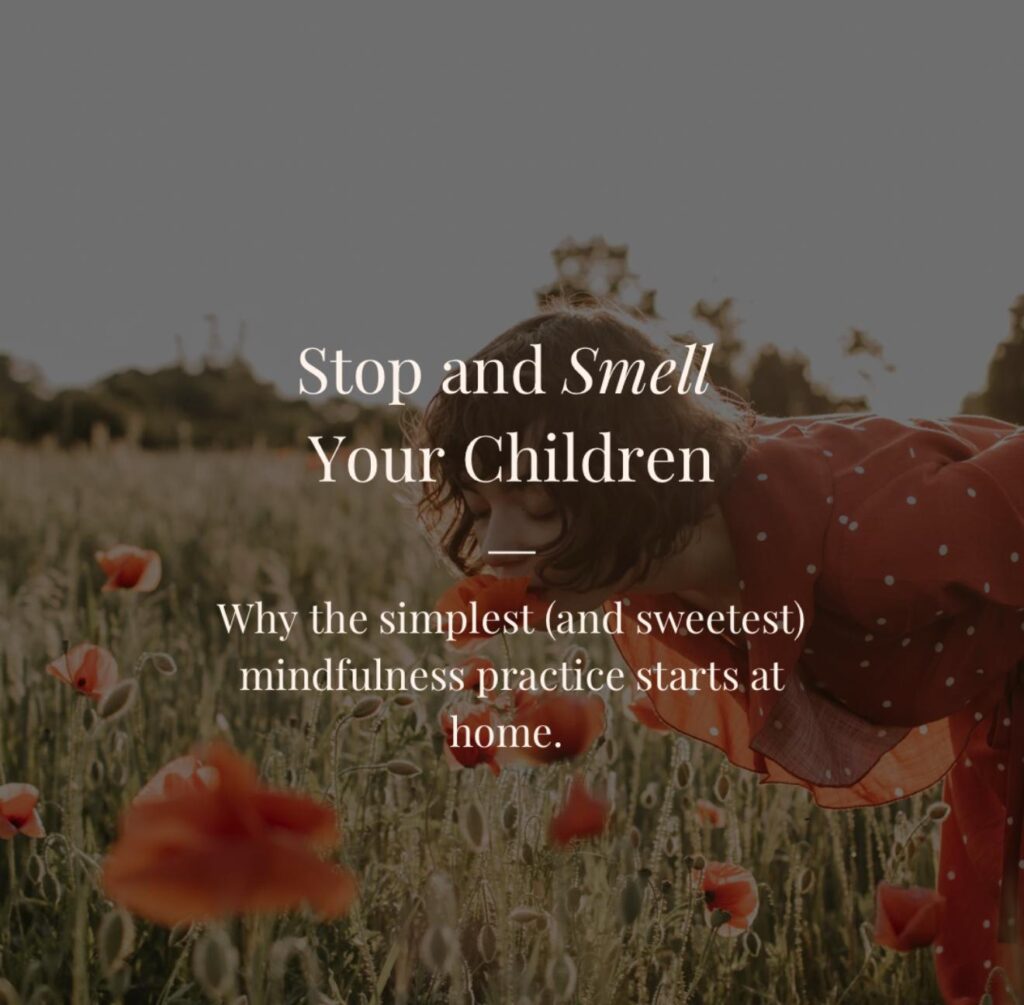
Yes. That’s what I said. Just stop and smell them. Smell their hair, their bellies, their armpits, and, most of all, their feet. Whatever age they are, just smell them.
Why are we supposed to stop and smell the roses? Why are we supposed to slow down and be mindful of our surroundings? Because life is often fast paced, whether you are leading a team, building a company, or managing a household.
So how do you stop and smell the roses? How do you accomplish this basic, time-tested approach to life? Well, first, stop and smell your children.
Happiness research suggests we are happiest when we are present, doing one thing at a time. Often, though, our loved ones are not offered the same attention and respect we may give others. Personally, when I am with patients, my ringer is off and messages can wait. I may not even have my phone in the room with me. My kids certainly deserve that same attention, at least some of the time!
Smelling roses is about being mindful, recognizing and appreciating the beauty around us: the sights, sounds, smells, and textures of leaves, birds, the sky, the ocean, trees, sand, mud, the earth after the rain. But what about our kids, the people we love most? I say, stop and smell them, too. See them, hear them, feel them, and smell them.
Here are a few ideas on mindful parenting, which, it turns out, is happier parenting and leads to improved parent-child relationships.
- Take ten to fifteen minutes a day to be with your child. Being with your child (or your partner or friend) means giving all of your attention. No phones, no devices, no distractions. With younger kids, this is referred to as Special Time or child-led play, where the adult acknowledges a distraction-free, time-limited period to observe, comment on, and mimic a child’s play. “I see you’re making purple elephants,” or “I like how you made that tower” or “That’s a cool helicopter you’re drawing. Maybe I will try to draw one, too.” As kids get older, I recommend the same concept, evolved. Just being there, without any distractions, will give you a sense of presence with your children. Let your tween or teen know that you are going to spend time with them, without phones or electronics, and just be. If this is a reach, set a lunch date, or a grocery run, or have cars be device-free zones. Ride in silence until someone breaks it.
- Write your child an occasional love letter. It does not have to be long– even a short note works. You do have to be specific: “To my favorite tween, I kind of love when you look slightly annoyed at me and say, ‘Stop it, Mom,’ but then give me a hug,” or “You are the best kitchen helper ever!” or “Thank you for setting the table even when you had so much homework,” or “Cleaning up was so fun with you yesterday!” Your child will feel seen and you will feel lighter.
- Incorporate a gratitude exercise into your day. Gratitude and mindfulness are intertwined. Take a moment to appreciate that your kid gave you a quick hug (and smelled so yummy!) or peed on the potty or got out the door without any blow-ups. Close your eyes and see the face that makes you happy.
- Put your phone somewhere you cannot see it during family time. This includes meals, family movies, family activities, and car rides, which, for some families, are the best opportunities for conversation. Believe me, it is liberating to forget where you put your phone.
- Take a walk with your family. Go on a hike or just a neighborhood walk. With younger kids, do a scavenger hunt together. Maybe look for three animals (or insects!), three different colored flowers, and three distinct sounds. With older kids, you can just walk together and see where the conversation takes you. Remember to review the ground rules beforehand: phones are put away. Eventually, even moody teens will talk.
Lastly, But Most Importantly
Stop and smell your children. If they are babies, start smelling those feet and don’t ever stop. If they are older, especially if they are stinky teenagers, just do it. When they are just getting out of bed or even if they are sweaty after a game, take those feet and give them a deep inhale. Even if this results in some less than pleasant olfactory activation, you and your child will have a great laugh in the moment. You will feel your love molecules come flooding through your bloodstream and warm your heart. And in the long-term, that connection and positive sensation will endure.
Thank you for reading my human-generated articles! If you found this helpful or educational, please share, follow on your preferred platform, or subscribe below. For coaching or consultations, please contact me at www.DrAngel.com.
References:
Bethell C, Jones J, Gombojav N, Linkenbach J, Sege R. Positive Childhood Experiences and Adult Mental and Relational Health in a Statewide Sample: Associations Across Adverse Childhood Experiences Levels. JAMA Pediatr. 2019;173(11):e193007. doi:10.1001/jamapediatrics.2019.3007
Potharst, Eva S et al. “A Randomized Control Trial Evaluating an Online Mindful Parenting Training for Mothers With Elevated Parental Stress.” Frontiers in psychology vol. 10 1550. 17 Jul. 2019, doi:10.3389/fpsyg.2019.01550
https://amchp.org/wp-content/uploads/2022/08/Promising-Handout-Hand-in-Hand.pdf
Hölzel, Britta K et al. “Mindfulness practice leads to increases in regional brain gray matter density.” Psychiatry research vol. 191,1 (2011): 36-43. doi:10.1016/j.pscychresns.2010.08.006