How Do You Encourage Your Girls to Stand Up For Themselves?
In honor of Women’s History Month, my kids’ school had a lovely event where friends of the school portrayed various women who changed history. I became Malala Yousefzai for the day, sharing the message of speaking up, the power of pens and teachers, and advocating for girls’ education around the world.
Malala became a target for the Taliban because she did not stay quiet when the Taliban destroyed hundreds of schools and threatened families who tried to send their girls to school. To silence her, a Taliban member shot her in the head. After a 10 day coma, she awoke with a left sided facial palsy, but rather than silencing her, the incident left her further resolute in advocating for the right to an education.
Many of us are not as strong as Malala. A bully on the playground might keep us from ever singing while swinging. A public poke at a loud outfit may leave us wearing muted colors forever. A jab at our ethnicity could sever us from the rituals and identity that we cherish.
So how can we encourage girls —or kids in general —to stand up for themselves?
I focus on girls not just because it is women’s history month, but because, historically, girls are more likely to be overlooked or have their concerns dismissed. As parents, supervisors, educators, and employers, we are in a position to shape young people, and we should be deliberate in elevating them.
Role Model.
In a recent attempt to speak up for what I thought was right, I confronted a man from my neighborhood after he flew through a stop sign. Two of my kids were with me, and they heard the entire conversation, including when he called me a derogatory term (with his own three-year-old daughter present). I was stunned into silence. A few weeks later, I asked my kids what they took away from that situation. They said they saw me stand up for myself, and they saw the neighbor shirk responsibility, deflect, and “be mean.”
As much as I cringe recalling that morning, I did the right thing. I stood up for what I thought was right, and my kids saw that. Sometimes, it is not worth picking a fight at that moment, but other times, your opinion matters, your idea matters, your feelings matter, and your voice matters. Your children will see you, they will hear you, and when the time comes, they will channel you.
Acknowledge their courage.
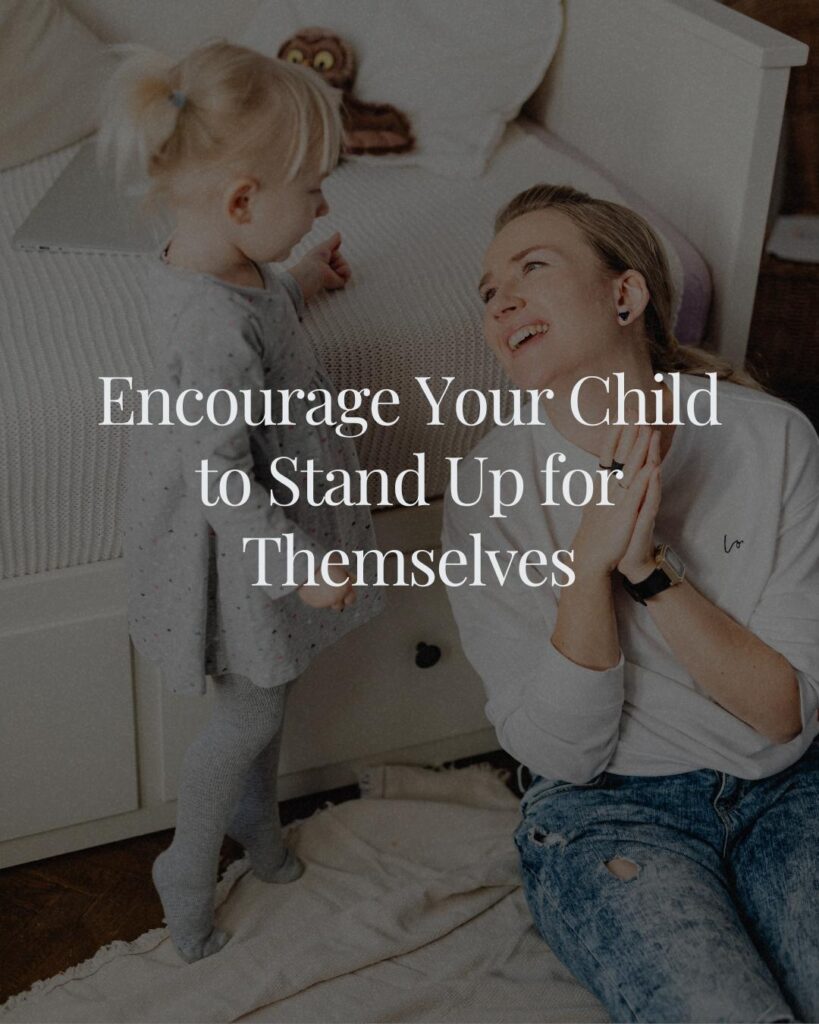
When your child stands up or speaks out for herself or someone else, praise her. I love how you firmly but kindly told your brother to let go of you. It was a nice hug when it started, but clearly you had enough. Or I was so impressed when Ms. Feech told me you volunteered to read aloud today. That was brave! Or That was really nice of you to tell that kid to stop taking your brother’s toys. It takes courage to speak your mind. Or That’s good of you to defend your sister. She’s having a hard time getting herself together, and I am sure she appreciates you explaining the situation for her.
Tell them that speaking up is important.
Be frank. Tell your kid that if they don’t speak up, they won’t be heard, and what they have to say is valuable. Play this out in your own home by making shared decisions, whether about which Legos to play with, where to go for dinner, what movie to watch, or what Mom should wear to that special work event. Incorporating their ideas tells your children their voices matter. When opportunities arise, share your own experience with standing up for yourself or times when you wish you had.
Create opportunities to speak for themselves.
Starting as soon as your kids can speak sentences, teach them how to politely speak up for themselves. Whether ordering a meal at a restaurant or asking the librarian for a specific book, prepare your kids by role-playing ahead of time. Toddlers who say, “Milk, please,” will soon be able to say, “May I please have the pasta in red sauce?” This is an early version of advocating for themselves (and learning about eye contact and manners!) and ultimately understanding what it feels like to be heard.
Teach them to keep physical boundaries.
In kindergarten, my kids were taught to say, “No, please don’t touch me,” or “Please step back. You’re too close to me,” if classmates encroached in their personal space. This normalized expectations for all parties, helping kids set and respect boundaries. Establishing these norms at a young age empowers kids, and teaches them they have autonomy over their bodies.
Don’t force them to hug people.
I may offend some grandparents here, but I do not think kids should be forced to hug people or sit on their laps (and that goes for Santa, also). This confuses the message that we tried to teach them earlier: you control your personal space. Next time you find yourself visiting old friends or relatives, improve your child’s comfort level in advance by sharing stories, photos, or videos from when they were last together, and upon seeing the person who expects a hug, let them know that your kid may prefer a wave or a fist bump over a hug.
Takeaways.
Speaking up and standing up for ourselves is a learned skill. You can encourage speaking up by role modeling, praising your child when you see them speak up, soliciting ideas from your kids, and teaching them that they decide who can be in their personal space. If you work with young women, encourage them to speak up, incorporate their ideas into the workplace, and remind them that their contributions are valuable.
Thank you for reading my human-generated articles! If you found this helpful or educational, please share, follow on your preferred platform, or subscribe below. For coaching or consultations, please contact me at www.DrAngel.com.
References:
Taiyi Yan, Thomas, et al. “How Employees Learn to Speak up from Their Leaders: Gender Congruity Effects in the Development of Voice Self-Efficacy.” Journal of Applied Psychology, vol. 107, no. 4, Apr. 2022, pp. 650–667, https://doi.org/10.1037/apl0000892. Accessed 17 Mar. 2026.